Beginner’s Guide to Watercolor Terms: Why I Created The Watercolor Dictionary
✅ Quick Overview
-
Why watercolor terms can feel confusing — especially at the beginning
-
How understanding the language supports confidence and skill growth
-
What makes The Watercolor Dictionary a practical, painter-focused reference focused entirely on watercolor
-
How to use it flexibly at your painting table, by your sketchbook, or in your field kit
-
Where to find the dictionary, and how it serves as your watercolor "word list" and "understanding tool" in one volume
Introduction — Why a Watercolor Dictionary?
When I first started watercolor painting, I assumed the hardest part would be learning how to paint.
Instead, it was learning how to understand the language.
I remember watching beginner tutorials and hearing phrases like “start with a light wash” or “check the pigment code before you mix.” Everyone moved on as if those words were obvious. I paused the video, looked at my supplies, and wondered if I had somehow missed an earlier section everyone else had watched.
I didn’t yet understand that a wash refers to a large area of color laid across the paper, or that pigment codes tell you exactly what pigments are inside a paint — information that matters when you’re learning to paint with watercolor, mix colors, and choose supplies.
When I tried to look these terms up, I found explanations scattered across multiple books and online sources that were often technical or written for experienced artists. Instead of clarity, I ended up with more tabs open and more uncertainty than before.
That early experience stayed with me.
Watercolor beginners don’t just need how-to instructions — they need clear, approachable language that helps everything else make sense. Understanding the words behind the materials and techniques changes how confidently you paint and practice on your own.
Clear language plays a larger role in learning watercolor than many beginners realize. Writing more than 50 educational posts for this blog helped clarify that pattern even further.
That’s why I created The Watercolor Dictionary — a reference designed to meet painters where they are, and to support clarity and understanding.
What’s Inside The Watercolor Dictionary
The Watercolor Dictionary includes 275+ watercolor terms and phrases, organized alphabetically for easy reference.
While many art resources touch on watercolor terminology, this resource brings watercolor-specific language together into one dedicated volume. It focuses entirely on the materials, techniques, and concepts watercolorists encounter in real painting practice — from early supply decisions to more nuanced discussions of technique.
Each entry is written in clear, straightforward language, with the goal of helping you understand:
-
what the term means
-
why it matters in watercolor
-
how it functions within the painting process
In addition to the alphabetical entries, the book includes an Appendix that groups terms by topic, such as:
-
Paper
-
Paint
-
Brushes
-
Techniques
-
General watercolor concepts
These grouped sections offer a broader view of how related terms connect, making it easier to build understanding gradually and revisit concepts as your experience grows.
The Dictionary is a versatile reference — something that can live on your studio table, sit beside your sketchbook, or be tucked into a watercolor tote or field kit to take along.
The Watercolor Dictionary is meant to move with your practice and be there whenever a question arises. It’s specifically designed to remain useful over time as your experience grows.
Why It Matters to Know the Terms
Learning watercolor isn’t just about brushstrokes and color — it’s also about learning the language of the medium.
Knowing the terminology is empowering and builds practical confidence. It helps tutorials make sense, reduces hesitation when choosing supplies, and clarifies how watercolor techniques and materials actually function — supporting steady skill growth over time.
When you understand the words, you spend less time second-guessing and more time painting. You begin to recognize how different concepts fit together, and your decisions start to feel more intentional.
Language doesn’t replace practice — but it supports it in meaningful ways. Every term you understand makes the next step feel more approachable.
That desire for clarity — not just definitions, but understanding — shaped every decision behind The Watercolor Dictionary.
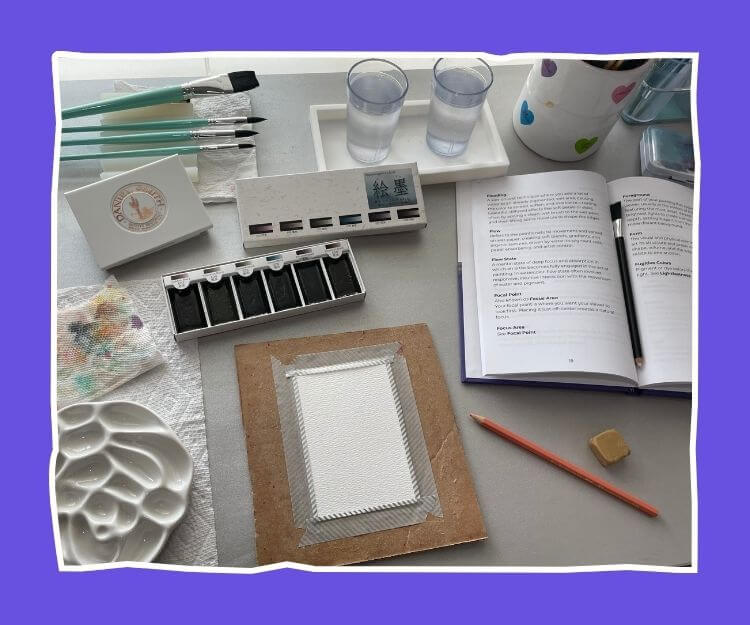
Author copy of The Watercolor Dictionary resting on a studio table with watercolor paints, brushes, and a simple watercolor project setup.
How to Use the Dictionary
Like most dictionaries, this isn’t a book you’re meant to read straight through.
Instead, The Watercolor Dictionary is designed to be used alongside your practice, in whatever way fits your routine:
-
Keep it on your painting table or desk for quick lookups
-
Refer to it when a term appears in a tutorial, book, or supply list
-
Pair it with watercolor guides or exercises while you practice
-
Flip to the Appendix to review related terms within a broader watercolor category
You might reach for it while planning a painting, mid-practice when a question comes up, or later when reflecting on what you’ve learned. It’s meant to support your watercolor learning over time — not interrupt it.
Where to Find It
The Watercolor Dictionary is available on Amazon in hardback and paperback formats.
While it’s especially helpful for beginners, The Watercolor Dictionary is designed to remain useful over time — supporting watercolorists at different stages as their understanding deepens.
👉 Get The Watercolor Dictionary on Amazon — a practical watercolor reference for your desk, bookshelf, or field kit.
💬 Closing Thoughts for Today
Learning the language is part of learning the art — and you don’t have to learn it all at once.
Every term you understand adds clarity. Every bit of clarity supports confidence. And confidence makes it easier to keep showing up to paint.
Your next step doesn’t need to be bigger or more complicated — it can simply be understanding the words you encounter as you keep painting.
If you’ve ever paused mid-tutorial to wonder what a word really meant, The Watercolor Dictionary was created with that exact moment in mind.
🔗 Recommended for You
Author