
How Watercolor Studies Fit Into Beginner Practice

A birthday card recently caught my attention for all the reasons you might expect: warm Mediterranean colors, a deep blue doorway, patterned tile, leafy branches, and a glimpse of water beyond the wall.
And almost immediately, I wanted to paint it.
Not as a copy to reproduce or share as my own design, but as a watercolor study — a small painting exercise that gave me something interesting to look at, interpret, and learn from.
What Is a Watercolor Study?
A watercolor study is simply a painting made for the purpose of learning.
You might study color, composition, brushstrokes, values, shapes, or how a particular subject can be translated into watercolor. The goal doesn't have to be creating a finished piece. The painting itself is the practice.
For this study, I wasn't trying to reproduce every detail of the birthday card. I simplified the scene and made choices along the way: which shapes to keep, which details to leave out, how to interpret the orange walls and blue doorway, and how much information I actually needed to suggest the tree, plants, tiles, sky, and water.
That decision-making became part of the exercise.
What Can Beginners Learn From Painting a Study?
One benefit of working from an existing reference is that you don't have to make every creative decision before you even pick up your brush.
The subject and basic composition are already there. That leaves room to concentrate on questions such as:
-
How can I simplify this shape?
-
Which colors are most important to the scene?
-
What details can I suggest rather than carefully reproduce?
-
Where do I want the viewer's eye to go?
-
What happens if my version looks different from the reference?
And it probably will look different.
That's part of what makes a study useful. You're learning how you see and translate the reference through watercolor.
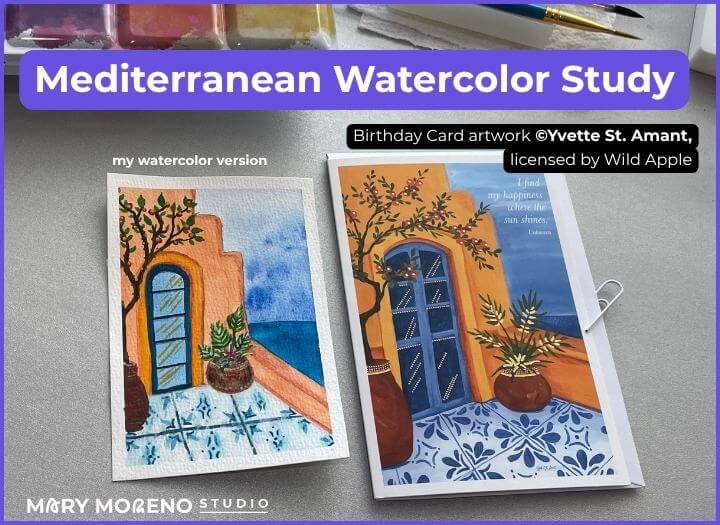
Image of my watercolor study version of this Mediterranean Birthday Card (Pictura, Inc.).
What This Mediterranean Watercolor Study Taught Me
As I painted, I found myself simplifying many of the shapes in the original card rather than trying to reproduce every detail. The blue doorway and warm orange walls became the main color relationship I wanted to preserve, while the tree, potted plant, tiles, and distant water could all be suggested with much less information.
Looking at the finished study, there are also choices I would make differently next time. I might simplify the tiles even further, and orient them more in line with the door. I would use a lighter color for the tree planter — I went a bit too dark with that, I think. And I would apply masking fluid in the leaf/bloom areas — before painting the wash on the walls — so that the leaves and flowers pop more.
That, too, is part of the value of a study: when you're finished, you can look back and ask not only What worked? but What would I try differently next time?
I really enjoyed creating this Mediterranean study — not only painting it, but thinking through how I wanted to interpret the scene in watercolor. Once it had dried, I texted a photo to my sister, who had sent me the birthday card, and told her I had painted it because I loved the image so much. It felt like a fitting end to the experience: the card had inspired a painting session, the painting had given me something to learn from, and I found joy in the process along the way.
One Important Note About Reference Images
Artists have long used studies as part of the learning process, and those studies are often based on photographs, paintings, illustrations, or other reference material created by someone else.
When the reference isn't your own, it's important to keep that distinction in mind. A study based closely on someone else's creative work is best treated as personal learning and practice, rather than artwork to sell, license, reproduce commercially, or present as an original composition.
For me, this birthday card was simply an opportunity to spend some time looking closely, painting thoughtfully, and seeing what I could discover from the process.
💬 What I Hope You Take From This
Not every watercolor session needs to begin with an original idea or end with a finished project.
Sometimes an image catches your eye and makes you want to pick up your brush.
Turning it into a study can be a worthwhile part of beginner practice — because the point isn't to create another version of someone else's artwork.
The point is to notice what you learn while painting it — and to enjoy the process itself.
👉 Recommended for You
Beginner's Guide to Using Reference Images for Creative Inspiration — discover free resources for high-quality images and explore more ways to boost your watercolor creativity in this mini-guide.
Author