Simple 10-Minute Watercolor Flower Field — One Easy Stroke
One thin stroke, a whole little flower field — and nothing new to learn before you start.
If you've spent any time with the free Brushstroke Quickstart, you already know the Thin Stroke. It's the first stroke I teach, and the one that turns up in almost every watercolor painting — grasses, stems, fine lines, small details. Simple, and everywhere.
Today we're going to take that one stroke and turn it into a small painting. A little field of wildflowers. No new strokes. Nothing to buy. Just the thin stroke you've already been practicing, put to work.
So let's paint a flower field. 🌾
What You'll Need
-
A round brush — whatever size feels comfortable in your hand
-
Watercolor paper — a small piece is plenty
-
Two or three greens if you have them (one green is fine)
-
One or two bright colors for the flowers — poppy red, a warm yellow, a bright blue
-
A jar of clean water
If a color isn't in your set, mix something close or swap it out. This is a low-pressure session.
How Your Thin Stroke Shows Up Here
Everything in this little field is the thin stroke. Every blade of grass. Every stem. Every petal.
The drill many of you practiced in the Quickstart — those light, thin, upward lines — that's the whole painting. It's just standing up now, as grass, and reaching up, as flowers. Nothing here asks for a stroke you don't already know.
Step-by-Step: Paint the Flower Field
1. Set the ground. Near the bottom of your page, paint one or two light, thin horizontal strokes. That's the ground of your flower field — the line everything grows from.
2. Grow the grass. From that line, send lots of thin strokes upward.
- Some straight, some leaning a little.
- Vary the heights.
- Let a few tilt further than feels tidy.
- Use two or three greens if you have them, or stay with one.
This is the same upward thin stroke from your drill, standing up as grass.
3. Add a few tall stems. Here and there, reach a few taller thin strokes up above the grass. These are where most of your flowers will sit.
4. Top them with tiny wildflowers. At the tip of each tall stem, paint a small fan of three or four short thin strokes in a bright color — little starbursts of poppy red or blue. Still all thin strokes. If your stems are still wet, let them dry briefly before adding the flowers so the colors stay separate.
5. Scatter a few floating marks. A handful of tiny thin marks drifting above the field read as seeds or loose petals on the breeze. Small, light, easy. They add a little depth.
💡 Tip: Start with fewer flowers than you think you want. You can always add one more — a field looks alive when it has a little room to breathe.
That's the whole field. Every blade and every petal, made from the one stroke you already know.
And here's the part I most want you to notice: You started with a familiar stroke. What's new is the flower field you created with it. That's the heart of everything I teach — practice is painting, and a small flower field on a random day absolutely counts.
👩🏻🎨 Artist's Note
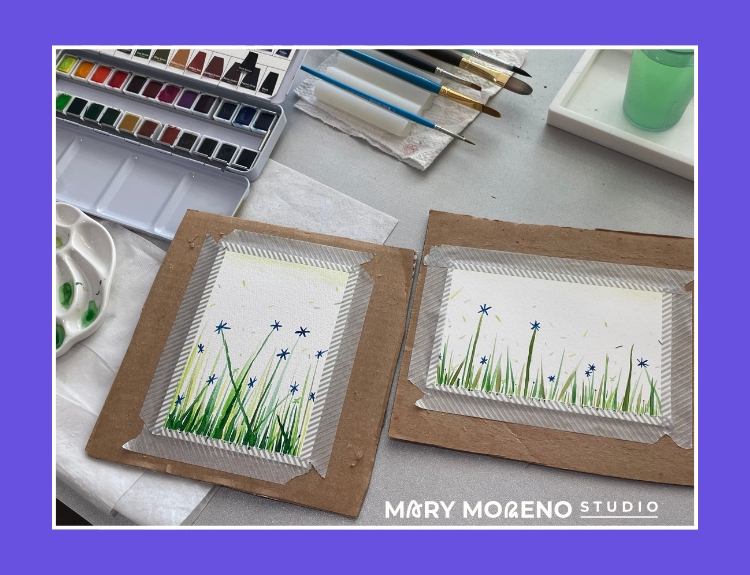
Mary Moreno's Easy One-Stroke Watercolor Flower Field, in vertical and horizontal formats.
I painted these one recent afternoon — I wanted to show this tutorial in both portrait and landscape formats.
- Three greens (Olive Green, Tree Green, and Grass Green) plus Lemon Yellow for the grass
- Ultramarine Blue for the flowers
- Round #1 brush
I let a few strokes lean further (and a bit wider) than felt neat — those turned out to be my favorite part.
Nothing sketched, nothing measured.
I just let the field tell me where it wanted to be full and where it wanted a little space.
I might have added a few extra-extra stems and strokes ... sometimes I lean to "more is more" instead of "less is more" lol.
Today's Key Takeaway
This project reminds us that a single stroke, repeated with a little variation, becomes a whole scene.
Before, the thin stroke was just a series of lines on a practice page. Today it's a field of flowers. Same stroke — different placement — and a little more play.
This is a painting you can make with the stroke you already have in your skill set, in about 10 minutes — small, quick, and complete. Begin right where you are.
Happy painting! 🌼
New here? The thin stroke starts in my free Brushstroke 3-Day Quickstart — three short sessions, one simple stroke, and you'll have everything you need to paint the field above. Whenever you're ready, you're welcome to begin.
Recommended for You
- For this project, I used my Andrea Nelson paints and brush — if you're wondering if they're beginner-friendly, here's my honest review of Andrea Nelson Watercolor Art Supplies.
Author